Charging a Rental EV at Your Bali Villa: 220V Guide
Yes — you can charge a rental EV at most Bali villas.
Yes — you can charge a rental EV at most Bali villas. Indonesia runs on 220V household power, the same voltage portable EV chargers are built for, and an overnight plug-in at the villa is how many of our guests cover their local driving without ever visiting a public charger. The rules that matter are about permission, socket condition and electrical load, not electronics expertise. This guide covers what is allowed, what is safe and what to skip, written for anyone whose home charging villa Bali plan is simply “park, plug in, sleep”.
Can you charge an electric car at a villa in Bali?
Yes, with two conditions: ask the villa manager first, and plug into one healthy wall socket rather than an extension-cord chain. Charging from 220V household power is slow but steady — an overnight session is a genuine top-up that offsets a day of local driving, billed through the villa’s ordinary meter.
Why ask the villa manager first?
Three reasons. The electricity lands on the villa’s meter, and some properties run prepaid meters that a night of charging drains faster than the host budgeted. Some villas also run on limited PLN capacity, where a charger competing with air-conditioning and a pool pump will trip the breaker. Asking first turns all of this into a two-minute conversation instead of a midnight blackout.
Hosts in EV-heavy pockets such as Canggu and Umalas increasingly say yes without blinking — EV charging at a villa in Bali is becoming a standard guest question. Some will ask you to charge overnight only, or request a fair contribution toward the electricity. Both are reasonable, and we do not quote a per-kWh home rate because household billing varies property to property.
The safe villa charging setup: six rules
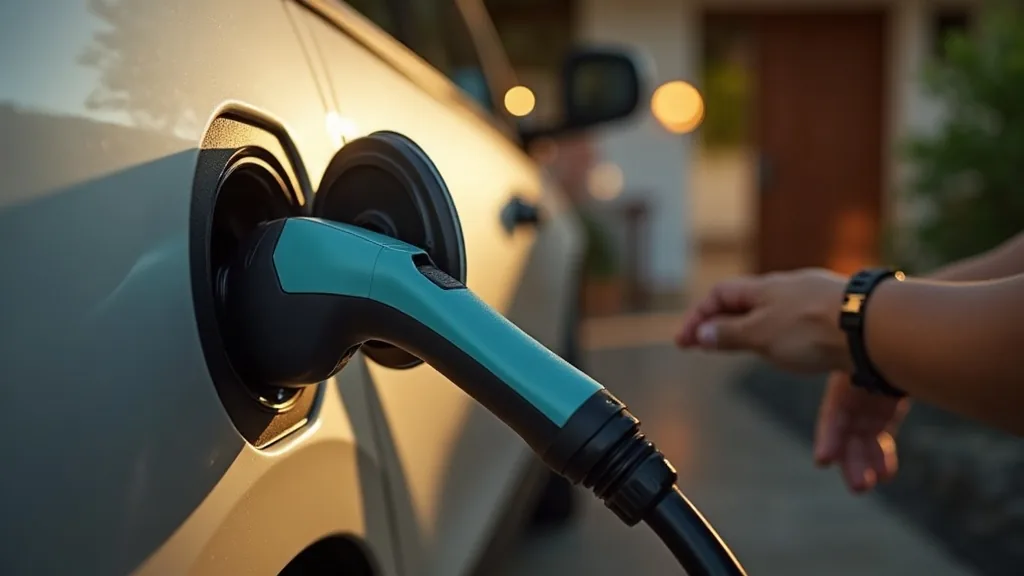
- Use the portable charging cable matched to the car — ask us on WhatsApp to include one at delivery — and never improvise with a travel adapter.
- Pick one wall socket in good condition, indoors or fully sheltered. A loose, scorched or crackling socket is disqualified on the spot.
- No daisy chains: skip power strips, splitters and long household extension cords, which are the classic overheating path.
- Keep the plug, cable and charging unit dry and off the ground — Bali downpours and exposed outdoor sockets are a bad pair, and EV charging safety in the rainy season is mostly about this one habit.
- Start the session in the evening when the villa’s other loads are low, and let it run overnight.
- If the breaker trips, stop and message us. Repeatedly resetting a struggling circuit is how sockets and equipment get damaged.
How much range does an overnight villa charge add?
Enough for local days, not for expeditions. Household 220V charging is the slowest kind, and the exact gain depends on the car and the socket, so the honest planning rule is: treat overnight EV charging at the villa as a top-up that offsets each day’s local driving, and schedule a public fast-charge session before any long leg to Ubud, Amed or Lovina.
We deliberately do not quote watts or kilometres-per-hour for villa charging, because the truthful answer varies socket by socket. The pattern that works in practice: plug in at night, wake up with meaningfully more charge, and let Bali’s 230-unit public SPKLU network handle the heavy lifting on road-trip days.
Do you need a wallbox or villa charger installation?
Not for a rental. Villa charger installation services exist in Bali for owners going electric long-term, but a visiting renter needs nothing more than the supplied portable EV charger cable and a sound socket. If you are staying a month or more and want faster home charging installation, raise it with the villa owner — that is their electrical decision, not something to improvise on holiday.
What about charging at hotels and resorts?
A number of resorts, particularly around Nusa Dua and Seminyak, have begun offering destination charging for guests — worth one message to the concierge before arrival. No verified island-wide list of hotel EV charging in Bali exists yet, so treat any resort charger as a bonus rather than the plan.
Charging etiquette applies wherever you plug in: move the car once the session is done rather than treating the charging bay as reserved parking, and never unplug another guest’s car. Where a resort has no charger of its own, staff can usually point you to the nearest public SPKLU.
Which plugs and connectors will you deal with?
On the wall side: standard Indonesian 220V two-pin sockets, the Type C/F pattern familiar across Europe and much of Asia. On the car side: modern EVs rented in Indonesia use a Type 2 inlet for AC charging — which is what the portable cable feeds — and the CCS2 plug type for DC fast charging at public stations. If you have charged an EV in Europe, none of the EV connector types in Indonesia will surprise you.
How should you hand the battery back?
Bali’s rental market, ours included, works on a fair-battery basis rather than the fuel-station full-to-full ritual. The car arrives with a high state of charge; return it with a reasonable level rather than running it to the last percent, and nobody is chasing charging receipts at handover. The exact expectation is confirmed on WhatsApp when you book, so there are no surprises at drop-off.
The one-paragraph villa charging playbook
Ask the host on day one. Plug the supplied cable into one good, sheltered socket in the evening. Let it run overnight, unplug in the morning, and top up at a public fast charger before any long drive. That is the whole discipline — and it is enough to make an EV the lowest-effort car you have ever holidayed with.
Villa and hotel delivery is part of the service — free within the Kuta–Seminyak–Airport corridor and available across the island for a fee. Pick your car on the electric fleet page, from $29 per day as of August 2026, read the villa-country charging notes in our Canggu rental guide, or scan the FAQ. For EV rental with villa delivery anywhere in Bali, message us on WhatsApp at +62 811-2859-0000.
Leave a Reply